
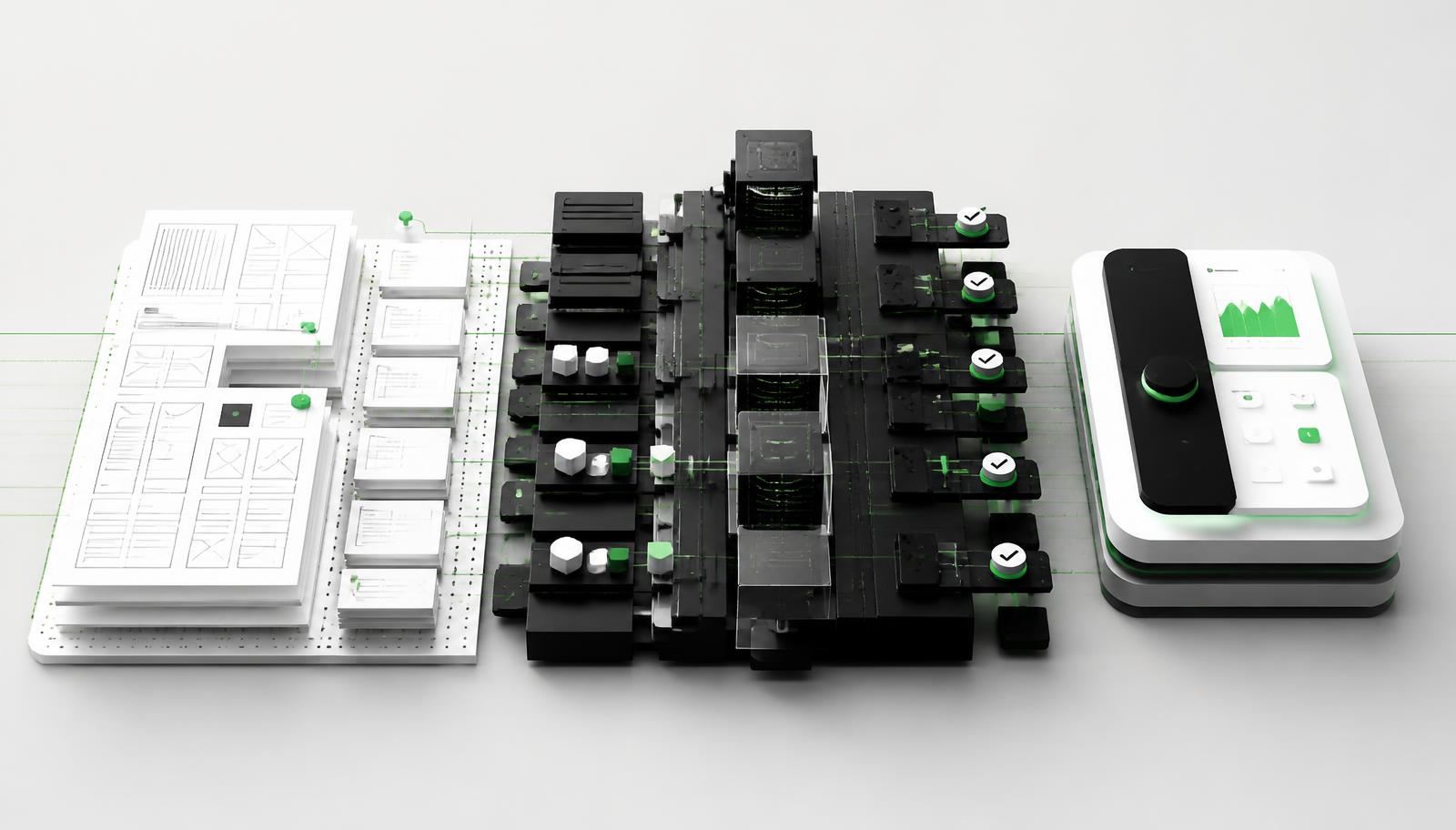
A board date is fixed. A competitor has shipped first. A legacy system is blocking revenue. In each case, leaders ask for speed. But a rapid software development process is not simply a team writing code faster. It is a production system that turns a defined product outcome into verified software without allowing ambiguity, shortcuts, or rework to consume the apparent time savings.
That distinction matters because traditional delivery is slow for reasons that have little to do with typing speed. Scope lives across documents and meetings. Architecture decisions are made inconsistently. Requirements change without a visible impact on estimates. Testing happens near the end, when defects are more expensive to fix. AI can accelerate isolated tasks, but it cannot correct an unmanaged operating model.
Why speed usually fails under traditional delivery
Most software projects do not miss deadlines because engineers lack talent. They miss them because the work reaches engineering in a form that cannot be executed cleanly. Product requirements may describe user intent but omit exception paths, permissions, integrations, reporting rules, and operational constraints. The team discovers those details while building, then repeatedly revises design, estimates, and code.
This is where conventional nearshore and agency models become expensive. A larger team appears to create momentum, yet coordination overhead grows with every new role, handoff, and clarification cycle. Status reports may show progress while the actual product remains difficult to test, deploy, or change.
Generative AI does not remove this problem by itself. Giving every engineer an AI coding assistant can make individual tasks faster, but it often creates variance in implementation choices, code style, dependency use, and test coverage. Prompt quality becomes a hidden delivery risk. The result may be faster code production without faster product delivery.
Commands, not prompts. The engineering team remains accountable for decisions, while the platform carries the repeatable parts of the process.
The rapid software development process starts before coding
The fastest reliable projects invest early in turning commercial intent into an executable system. This is not a return to long specification cycles. It is a short, structured discovery process designed to remove the uncertainty that causes downstream churn.
Define the product as a delivery system
A credible discovery phase establishes more than a feature list. It defines the user journeys that matter, business rules, roles and permissions, integration boundaries, data flows, nonfunctional requirements, release priorities, and acceptance criteria. It also identifies what is deliberately out of scope.
That output should be machine-readable enough to drive development work, testing, and estimation. If a requirement can be interpreted three ways, it is not ready for a delivery team or an AI-enabled workflow. The objective is not perfect prediction. It is reducing uncertainty to a level where the team can commit to a plan and explain the remaining assumptions.
Architecture belongs in this stage as well. Decisions about tenancy, authentication, data ownership, audit trails, performance thresholds, third-party services, and deployment environments are not technical details to postpone. They shape cost, delivery sequence, security exposure, and future maintenance.
Break scope into independently verifiable work
Once the product model is clear, scope becomes a set of ordered delivery units rather than a backlog of loosely connected tickets. Each unit needs defined behavior, technical constraints, expected test coverage, and acceptance evidence.
This changes the economics of delivery. Engineers spend less time translating vague requests. Product leaders can see what is being built, what has been verified, and what a change will affect. Estimates become more credible because they are based on defined work rather than a broad promise to build an application. It also creates a useful commercial boundary between committed scope, approved changes, and open questions.
Build through governed, repository-based workflows
The delivery engine is where many AI claims become difficult to defend. The relevant question is not whether a model can generate code. It is whether the team can generate, review, test, and release changes consistently across engineers and over time.
A governed workflow begins in the repository, where the actual product context lives. It should account for established patterns, architecture rules, coding standards, dependencies, existing tests, and deployment requirements. Engineers initiate fixed workflows for defined tasks, review the output, make judgment calls where the product requires them, and verify the change before it progresses.
Test while the work is still cheap to change
Quality cannot be a final project phase in a rapid model. By then, dependencies are tangled, release pressure is high, and teams are tempted to classify defects as post-launch work. Testing must run alongside delivery at several layers: unit behavior, integration paths, end-to-end user journeys, security checks, performance risks, and regression coverage.
Not every project needs the same test mix. A regulated internal system may require stronger audit and access-control evidence. A consumer SaaS launch may place greater emphasis on checkout, onboarding, mobile behavior, and load. The principle remains constant: testing should be connected to the defined scope, not left to informal manual checks.
Engineer-led QA remains necessary. Automated controls can identify patterns, validate expected behavior, and catch regressions at scale. They cannot fully judge confusing interactions, incomplete business logic, or whether a workflow makes sense for a real user. The right model combines automation with accountable human review rather than presenting one as a replacement for the other.
Measure quality as a delivery input, not a cleanup task
Technical debt is often treated as the price of moving fast. That is an outdated trade-off. Some debt is intentional and commercially rational, particularly when a team is validating a market or deferring a low-risk capability. Unmeasured debt is different. It quietly reduces change velocity, increases incidents, and makes future estimates unreliable.
Continuous technical quality analysis makes these risks visible as the product is built. The review should look beyond code formatting to dependency exposure, duplication, architecture drift, missing tests, security weaknesses, performance concerns, and maintainability hotspots. Each finding needs context. A long list of static-analysis warnings is not a quality strategy; prioritization and ownership are.
- Can the team add a feature without destabilizing adjacent workflows?
- Can it trace a change to a requirement and a test result?
- Can another team assume ownership without reconstructing the system from tribal knowledge?
What leaders should demand from a rapid delivery partner
A credible rapid delivery engagement should make its controls visible. Ask how scope is formalized, how estimates change when requirements change, how repository context informs AI-assisted work, and which quality checks are mandatory before release. Ask who owns architecture decisions, who reviews generated code, and what evidence confirms that a feature works.
Be cautious with blanket promises. A well-bounded SaaS product, internal workflow platform, or modernization program can often be delivered in a fraction of a traditional timeline. A project with unresolved strategy, complex legacy dependencies, multiple external approvals, or undefined data ownership cannot be made deterministic by adding AI. The right partner will expose those constraints early instead of hiding them behind a speed claim.
Commercial structure matters too. A fixed outcome requires a defined scope and explicit assumptions. If every request is accepted informally, neither price nor timeline is truly predictable. Strong delivery teams make change possible, but they make its impact visible before work begins.
Build the system before the deadline arrives
The organizations that deliver software faster are not those that ask engineers to work harder or collect the most AI tools. They remove ambiguity before implementation, encode expert practices into repeatable workflows, verify each increment continuously, and keep technical risk visible.
That is the standard worth applying to your next product launch or rebuild. Before approving a timeline, ask whether the delivery process can prove what will be built, how it will be tested, and who will own it when the launch pressure is gone.
Turn your next product outcome into an executable, governed delivery plan that moves fast without borrowing risk from the future.