
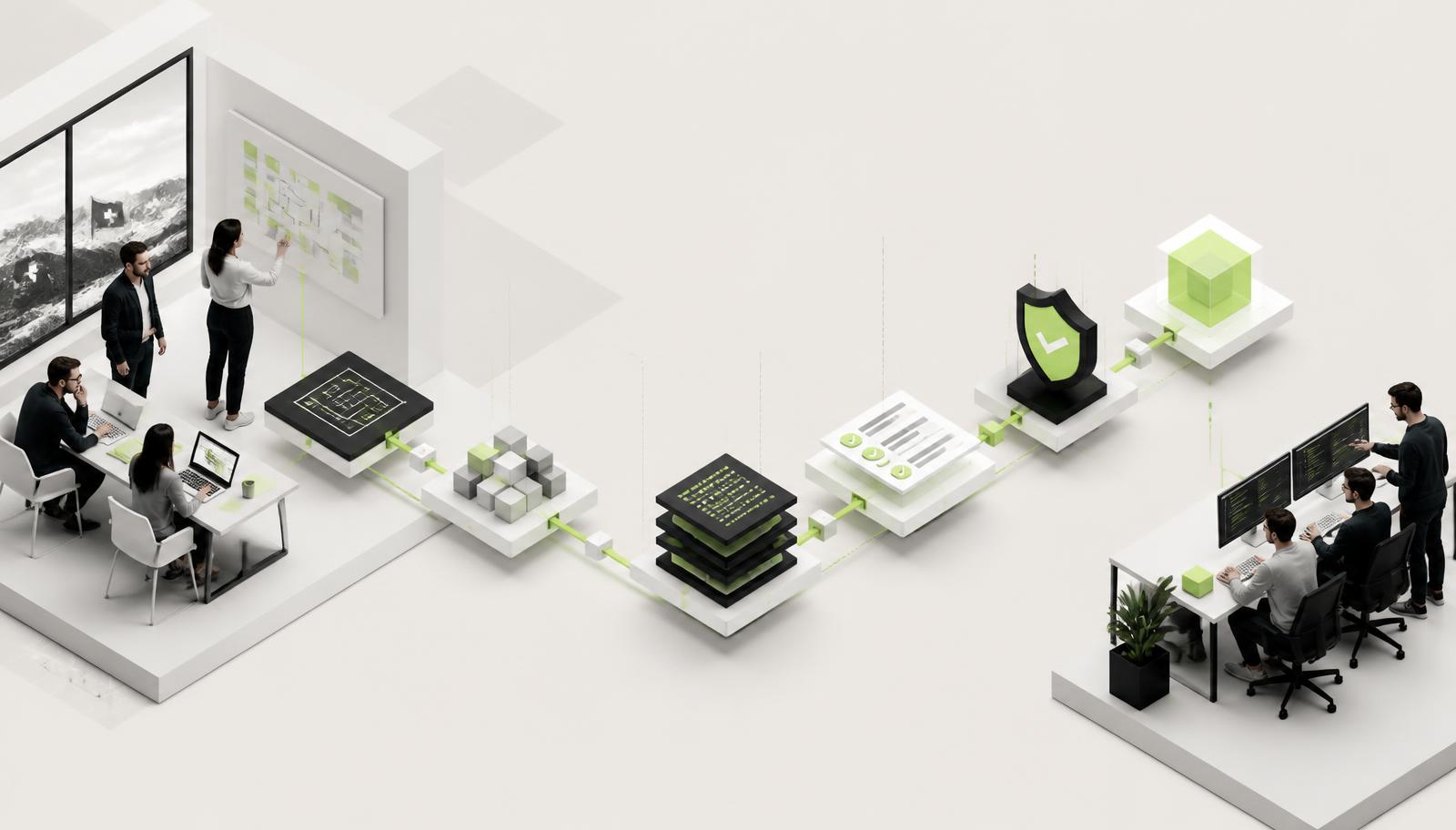
A board approves a new customer platform. A founder needs an MVP before the next funding milestone. A CIO has a legacy system creating operational risk every week it remains untouched. In each case, software development outsourcing is often treated as a procurement exercise: compare hourly rates, review resumes, choose a vendor, and start assigning tickets.
That model is the source of many outsourcing failures. The real purchase is not developer capacity. It is a delivery system capable of turning an uncertain business goal into a secure, testable, maintainable product on a known timeline. When that system is missing, lower rates simply make an uncontrolled project cheaper per hour, not cheaper overall.
Why Software Development Outsourcing Fails
Traditional outsourcing separates the decisions that determine success from the work that produces the code. A client provides a requirements document, a vendor estimates it, and an offshore or nearshore team begins implementation. Weeks later, questions emerge about edge cases, integrations, user roles, nonfunctional requirements, and what the original request actually meant. The estimate moves because the scope was never sufficiently defined.
The problem is not geography. Excellent engineering teams exist everywhere. The problem is an operating model that relies on handoffs, informal interpretation, and individual judgment to compensate for missing structure.
A vendor can show a strong portfolio and still struggle with your product because software delivery is contextual. A healthcare workflow, marketplace payment flow, enterprise permission model, or industrial data pipeline has rules that cannot be inferred from a few screens and a backlog. If those rules are not translated into an executable specification, they reappear later as rework, defects, change requests, and technical debt.
This is why outsourcing cost should be evaluated as total delivery cost. That includes the client time required to clarify decisions, the cost of delayed market entry, the effort spent correcting misunderstood requirements, and the future cost of maintaining shortcuts. A low initial proposal can become the most expensive path when uncertainty is priced out of the sales process and back into the project.
AI Does Not Fix an Undisciplined Delivery Model
Generative AI has changed the economics of producing code, but it has not removed the need for engineering control. Giving a conventional outsourced team coding assistants may improve individual throughput. It does not automatically create consistent estimates, enforce architecture rules, validate security assumptions, or prove that a release meets acceptance criteria.
Free-form prompting also introduces variance. Two engineers can ask for the same feature in different ways, receive different outputs, and make different architectural choices. That is tolerable for experimentation. It is not an adequate foundation for a product with regulatory requirements, production users, integrations, and a multi-year maintenance horizon.
The meaningful shift is from AI-assisted coding to governed AI-enabled delivery. Commands, not prompts.
In a governed model, engineers initiate fixed commands and workflows that operate against the repository, defined scope, architecture constraints, and test requirements. The platform generates and executes work within those boundaries, then records what changed and which controls passed. AI can compress build time substantially when work is well defined and the pipeline can verify the output. It cannot responsibly turn an unresolved product strategy into production software overnight.
The Operating Model to Buy Instead
A reliable outsourcing engagement begins before development starts. Discovery should be a formal engineering and product process, not a brief kickoff call followed by a large estimate.
1. Convert intent into machine-readable scope
Identify what the product must do, for whom, under which conditions, and how success will be verified. Map user journeys, business rules, integrations, permissions, data flows, exceptions, measurable acceptance criteria, and what is deliberately out of scope. A quality discovery phase surfaces decisions early, when they are inexpensive.
The output should be more than slideware. It should create a structured source of truth that can drive estimation, development tasks, test cases, and change control. When scope changes, the impact should be visible rather than absorbed silently into a team’s workload.
2. Encode architecture and quality rules
Before feature delivery accelerates, the engagement needs explicit codebase rules: approved frameworks, module boundaries, API conventions, authentication patterns, error handling, performance expectations, observability, and deployment practices. These guardrails make speed repeatable and prevent a project from becoming a collection of individually reasonable decisions that are collectively difficult to maintain.
3. Build and verify in short, controlled cycles
Each change needs appropriate automated tests, code review, security checks, and engineer-led QA before it is complete. The exact test mix depends on the product, but the principle does not: a feature is not finished because code exists. It is finished when behavior has been validated against the agreed scope. Repository-based workflows make progress visible through implemented capabilities, test results, quality signals, and deployable increments.
4. Measure technical debt continuously
Technical debt is not post-launch housekeeping. It is a delivery risk that begins when shortcuts enter the repository. Continuous analysis can identify duplicated logic, vulnerable dependencies, complexity hotspots, weak test coverage, architectural drift, and performance risks while correction is still manageable. A provider should explain not only what it built, but how it monitors the condition of what it is building.
What Predictability Looks Like in a Contract
Predictable delivery does not mean pretending every unknown can be fixed on day one. It means making uncertainty explicit and managing it through evidence. Early estimates may be ranges that narrow as discovery resolves key decisions. The strongest engagements clearly define the unit of accountability: a discovery outcome, release scope, working product increment, or modernization milestone. They also state the assumptions behind timelines and budgets.
Be cautious with vendors that offer a fixed price before they can explain the scope, and equally cautious with time-and-materials arrangements that never produce a credible forecast. One creates false certainty; the other can create permanent ambiguity. The better model combines defined discovery, transparent assumptions, controlled change management, and evidence at each delivery gate.
Keep Product Ownership Close
Outsourcing should extend your organization’s capability, not remove its responsibility for product decisions. Internal leaders should retain ownership of commercial priorities, customer insight, risk tolerance, and final trade-offs. A delivery partner should make those decisions easier by exposing options, consequences, and evidence.
When speed is the objective, a smaller managed engineering team supported by a governed platform can often deliver comparable product scope in one-fifth to one-third of a traditional timeline, at materially lower cost. Those ratios depend on scope quality, integrations, regulatory demands, and the starting state of the codebase. They are not a substitute for discovery.
The practical question is not whether to outsource software development. It is whether the provider can show the system that converts your intent into verified software. Ask to see how scope becomes work, how work becomes tests, how tests become release evidence, and how the codebase is protected after launch. That is where delivery confidence is built.
Planning an outsourced product build or modernization? Start with a focused Rapid Discovery and get a defensible delivery plan.